 CN Electronics
A DC/DC-Power Converter changes one direct-current voltage into another. It may step 48 volts down to 12 volts, or raise 12 volts to 400 volts. These circuits support electric vehicles, solar storage, telecommunications, medical equipment, and data-center servers. Their work is often hidden inside a small metal enclosure. Yet that enclosure can manage substantial current and heat.
The basic process uses controlled switching. A transistor rapidly interrupts the input supply. An inductor stores energy, while capacitors smooth the output voltage. A controller adjusts the switching duty cycle when the load changes. Buck converters reduce voltage. Boost converters increase it. Buck-boost designs can perform both functions. Isolated versions add a transformer for safety and voltage separation.
The demand is becoming harder to ignore. The International Energy Agency reported that data centers consumed about 460 TWh of electricity globally in 2022. Its Electricity 2024 analysis projected consumption could exceed 1,000 TWh by 2026. Every conversion loss then matters. Even a small efficiency gap becomes significant across thousands of servers. The U.S. Department of Energy also identifies power electronics as essential to modern energy systems and electrification.
Efficiency is not the whole story. Engineers must balance thermal performance, electromagnetic interference, switching speed, cost, and reliability. A converter rated at 98% efficiency can still require serious cooling under heavy load. That detail is easy to miss. This guide explains how a DC/DC-Power Converter operates, compares common topologies, and examines the measurements that determine dependable real-world performance. Some simplified explanations remain useful, but they should not replace testing under actual voltage, temperature, and load conditions.
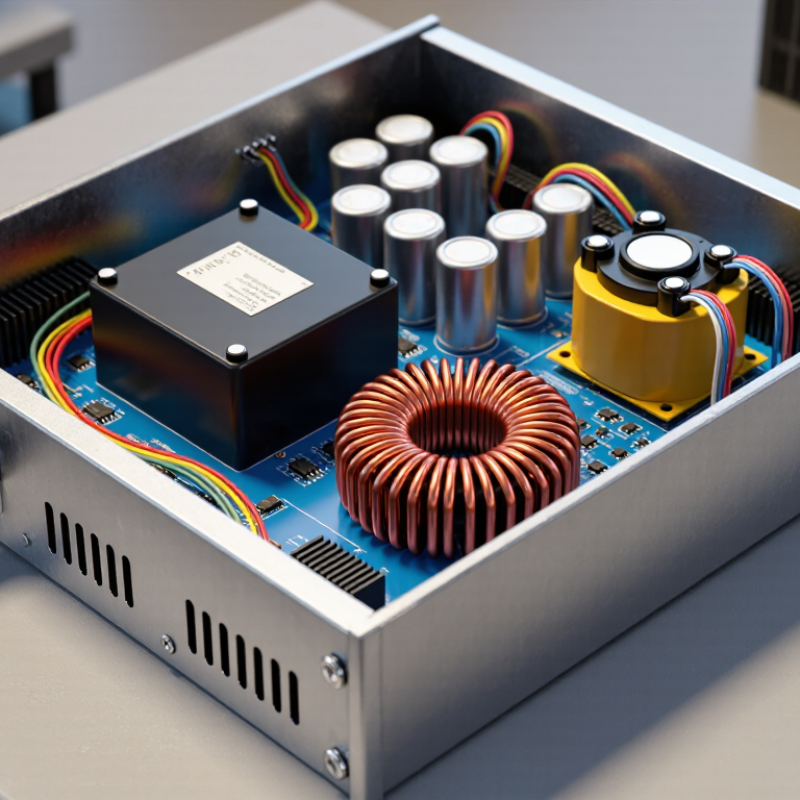
A DC-DC power converter changes one direct-current voltage into another. It may reduce 24 volts to 5 volts, or raise 3.7 volts to 12 volts. This function supports battery systems, sensors, control boards, and portable equipment. Unlike a simple resistor, a converter manages energy instead of wasting most of it as heat.
The basic process uses a high-speed electronic switch, an inductor, a capacitor, and a control circuit. The switch turns on and off rapidly. During each cycle, the inductor stores energy and then releases it to the load. The capacitor smooths the resulting pulses. A feedback circuit measures the output voltage and adjusts the switching pattern. Small changes in load can therefore receive a faster correction.
Different designs serve different needs. A buck converter lowers voltage, while a boost converter increases it. A buck-boost converter can perform both tasks when the input varies. Some converters also provide electrical isolation through a transformer, which can improve safety and system reliability.
In real projects, efficiency is never the whole story. Heat, ripple, electromagnetic noise, startup behavior, and load changes also matter. A converter rated for high current may still fail in a poorly ventilated enclosure. The simple explanation is useful, but incomplete. Designers should check thermal measurements and output waveforms under realistic conditions, not only trust the specification sheet. Even then, unexpected cable resistance or a sudden motor surge can expose a weakness.
| Converter Type | Primary Function | Typical Voltage Relationship | How It Works | Typical Efficiency | Common Applications | Key Design Considerations |
|---|---|---|---|---|---|---|
| Buck Converter | Reduces a higher DC input voltage to a lower DC output voltage. | Output voltage is lower than input voltage. | A switching transistor rapidly connects and disconnects the input. An inductor and capacitor smooth the switched waveform into a lower, regulated DC voltage. | Approximately 80%–95%, depending on switching frequency, load, components, and voltage ratio. | Embedded electronics, digital processors, sensors, communication equipment, and battery-powered devices. | Switching losses, inductor current rating, output ripple, thermal management, and electromagnetic interference. |
| Boost Converter | Raises a lower DC input voltage to a higher DC output voltage. | Output voltage is higher than input voltage. | The inductor stores energy while the switch is on and releases energy through the diode or synchronous switch when the switch is off, increasing the output voltage. | Approximately 80%–95% in many practical designs. | LED lighting, portable electronics, battery systems, and circuits requiring a voltage higher than the available battery voltage. | Input current, switch and diode voltage stress, inductor saturation, output ripple, and startup behavior. |
| Buck-Boost Converter | Can increase or decrease the input voltage. | Output voltage may be lower than, equal to, or higher than input voltage. | It combines energy-storage and switching principles to regulate the output across a changing input-voltage range. Different circuit arrangements may preserve or invert output polarity. | Approximately 75%–94%, depending on topology and operating conditions. | Battery-powered products, automotive electronics, instrumentation, and systems with a wide battery discharge range. | Polarity, control-loop stability, wide input range, current stress, and transition behavior around the input-output crossover point. |
| SEPIC Converter | Provides a regulated output that can be above or below the input while maintaining non-inverted polarity. | Output can be lower than or higher than input. | Two inductors and a coupling capacitor transfer energy through a switching network while keeping the output polarity positive relative to the input. | Approximately 75%–90% in typical implementations. | Automotive and industrial electronics, battery-powered equipment, and applications with fluctuating input voltage. | Two-inductor design, coupling-capacitor ripple current, component size, efficiency, and control complexity. |
| Flyback Converter | Converts DC voltage while providing electrical isolation when an isolated transformer is used. | Can step voltage up or down, depending on transformer turns ratio and duty cycle. | Energy is stored in the transformer magnetizing inductance while the switch is on and transferred to the output when the switch is off. | Approximately 70%–90%, depending on power level and design. | Low-to-medium power isolated supplies, industrial controls, chargers, and auxiliary power circuits. | Transformer design, leakage inductance, voltage spikes, insulation, snubber networks, and electromagnetic interference. |
| Forward Converter | Provides isolated DC conversion for higher power levels than many flyback designs. | Output voltage is determined by the transformer turns ratio, duty cycle, and input voltage. | Energy is transferred to the secondary side while the primary-side switch is on. Output inductors and capacitors then filter the pulsed energy. | Approximately 80%–95% in well-designed systems. | Industrial power supplies, telecommunications equipment, and medium-power control systems. | Transformer reset method, switch stress, output inductor design, isolation requirements, and control-loop response. |
| Push-Pull Converter | Uses alternating switching paths to drive an isolation transformer efficiently. | Can step voltage up or down according to the transformer turns ratio. | Two switches alternately energize opposite halves of a transformer primary, producing an alternating magnetic flux that is rectified on the secondary side. | Approximately 80%–95% in suitable power ranges. | Battery-powered inverters, isolated industrial converters, and medium-power DC power systems. | Transformer flux balance, switch timing, voltage spikes, dead time, and prevention of transformer saturation. |
| Resonant Converter | Improves switching performance by using resonant inductance and capacitance. | May provide step-up, step-down, or isolation depending on the topology and transformer ratio. | The switching network operates near a resonant frequency, allowing current or voltage to transition more softly and reducing switching losses. | Approximately 90%–97% in optimized applications. | High-efficiency power supplies, data-center equipment, battery chargers, and high-density systems. | Resonant-frequency control, load range, magnetics, operating frequency, and output regulation under changing conditions. |
| Linear DC Regulator | Produces a stable lower DC voltage without high-frequency switching. | Output voltage must be lower than input voltage. | A control transistor operates in its linear region and dissipates the voltage difference as heat while maintaining a regulated output. | Typically related to the voltage ratio; approximate efficiency is output voltage divided by input voltage. | Low-noise analog circuits, reference supplies, sensors, and low-current electronic equipment. | Heat dissipation, dropout voltage, load current, input-output voltage difference, and thermal protection. |
| Isolated DC-DC Converter | Transfers power between input and output while electrically separating the two sides. | Output may be lower, equal to, or higher than input. | A high-frequency transformer provides galvanic isolation while switching circuits, rectifiers, filters, and feedback regulate the output voltage. | Approximately 75%–95%, depending on topology, power level, and isolation requirements. | Medical equipment, industrial controls, communication systems, vehicle electronics, and safety-related circuits. | Isolation voltage, creepage and clearance, transformer insulation, leakage current, conducted emissions, and feedback method. |
| Non-Isolated DC-DC Converter | Changes voltage while maintaining a direct electrical connection between input and output grounds. | Output may be lower or higher than input, depending on topology. | Switches, inductors, capacitors, diodes, or synchronous switches regulate energy without using an isolating transformer. | Approximately 80%–97% in many applications. | Point-of-load regulators, consumer electronics, computers, battery systems, and embedded control boards. | Grounding, ripple, transient response, layout, electromagnetic interference, and thermal performance. |
It changes one direct-current voltage into another. It may raise, lower, or stabilize voltage.
A buck converter reduces voltage, such as changing 24 volts to 12 volts. Its output depends mainly on switching duty cycle.
A boost converter raises voltage above the input level. Battery-powered lighting systems often use this arrangement.
It can raise or lower voltage as battery voltage changes during discharge. Some circuits reverse polarity, while newer designs avoid it.
Isolated converters use a transformer between input and output. Non-isolated designs are usually smaller and more efficient at modest power levels.
Flyback, forward, half-bridge, and full-bridge designs are common. Flyback suits lower power, while full-bridge designs handle higher power.
They support vehicle lighting, sensors, control units, communication systems, and portable electronics. They also appear in industrial equipment and renewable energy systems.
They should check voltage, ripple, heat, switching losses, magnetic saturation, and electromagnetic noise. Test startup, full load, and unusual temperatures.
Yes. It may show the correct voltage while producing unstable ripple or excessive heat. An oscilloscope and proper load can reveal this.
No. They provide a starting point, not a guarantee. Wiring resistance, temperature, tolerances, and sudden loads can change real performance.
A DC/DC-Power Converter is an electronic device that changes one direct-current voltage level into another, either increasing, reducing, or regulating the output to meet a system’s requirements. It works by rapidly switching electrical current through inductors, capacitors, diodes, or controlled switching devices, then filtering and regulating the energy to produce a stable DC output. Feedback circuits continuously monitor the voltage and adjust the switching process for efficiency and reliability.
The main types include buck converters, boost converters, buck-boost converters, isolated converters, and linear regulators, each suited to different voltage and power conditions. Key specifications include input and output voltage ranges, current capacity, efficiency, switching frequency, ripple, thermal performance, and isolation requirements. DC-DC converters are widely used in battery-powered equipment, vehicles, industrial control systems, renewable-energy installations, telecommunications devices, computers, and consumer electronics, where dependable voltage conversion and power management are essential.
